


Single Mode vs Multi Mode FORJ: Performance Differences And Selection Guide
BY NBG
 2026-01-05
VIEWS: 170

Single-Mode vs Multi-Mode FORJ: Performance Differences & Selection Guide
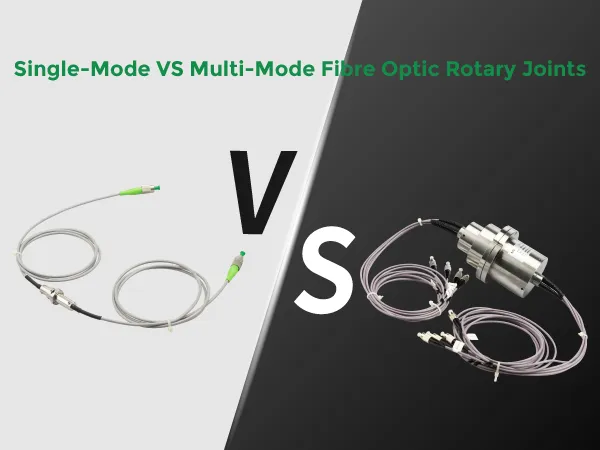
The decision between Single-Mode and Multi-Mode Fiber Optic Rotary Joints (FORJs) can have a great effect on the system performance, signal stability, and scalability. All types have their benefits and limitations (transmission distance, bandwidth, and signal quality). In this section, we discuss the performance differences between them, and a selection guide is provided.
Understanding FORJ Fundamentals
FORJs are needed in all cases where there is continuous rotation and high-speed optical data transfer.
What is a Fiber Optic Rotary Joint?
Fiber optic rotary joint (FORJ) can achieve continuous optical signal transmission between fixed components and rotating components. Unlike electrical slip rings, fiber optic rotary joints do not require current transmission and are widely used in the development of high bandwidth, electromagnetic interference free communication systems.
The Importance of Fiber Type Selection
The decision of single-mode or multi-mode fiber has a direct effect on performance, costs, mechanical tolerances, and the operation over long distances. The type of fiber, which is adopted, plays a decisive role in deciding the bandwidth, signal attenuation, and the complexity of the coupling, and thus it is important to align the selection with the needs of the system at the initial stages.
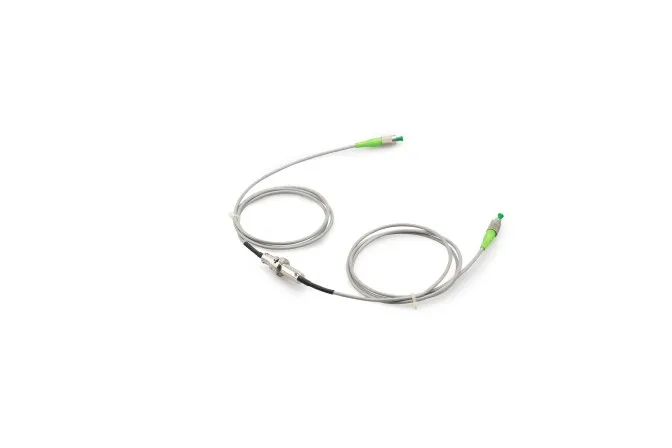
Single-Mode FORJ: Characteristics & Performance
Single-mode FORJs focus on precision, long-distance signaling, and premium data quality.
Technical Specifications
● Core diameter (8–10 μm) and light propagation characteristics: A narrow core allows only one propagation mode, reducing dispersion and maintaining signal integrity over very long distances.
● Wavelength ranges (1310 nm, 1550 nm, typical): These wavelengths are telecom-grade and enable low attenuation and high performance stability.
● Insertion loss specifications (0.1 to0. 3 dB): Single-mode FORJs have been engineered with low IL and can be relied upon to have good optical budget even in challenging configurations.
● Return loss performance (>40 dB typical): High RL reduces signal reflection, shields source lasers, and enhances overall system stability.
Performance Advantages
● Long-distance transmission capability: Single-mode systems can maintain extremely low signal transmission for tens to hundreds of kilometers.
● Increased bandwidth capability: The narrow propagation path enables very high data rates with high reliability.
● Reduced attenuation with range: Attenuation remains low even in complicated or mission-critical deployments.
● Minimal modal dispersion: The single propagation mode effectively eliminates timing delays caused by multiple light paths.
● High-speed application suitability: Superior signal quality suited for systems requiring precise data transfer, such as radar, aerospace imaging, and high-speed telecom.
Design Considerations
● Precision alignment requirement: The small core size demands the highest optical alignment between rotating fiber ends.
● Stricter manufacturing controls: Rigid machining increases the difficulty and cost of production.
● Influence on mechanical complexity and cost: These FORJs are generally more expensive due to their engineering complexity.
Multi-Mode FORJ: Characteristics & Performance
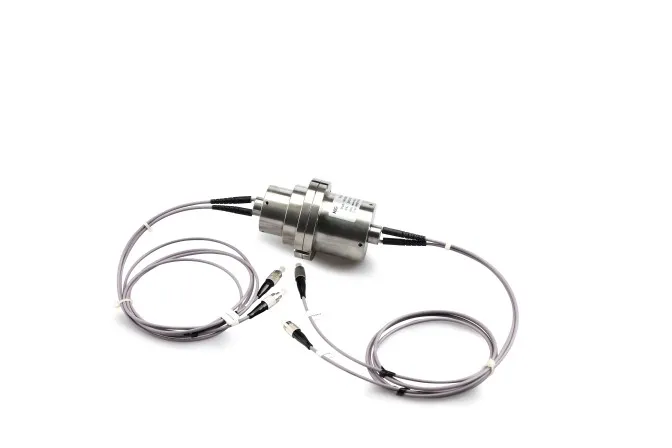
Multi-mode FORJs offer flexibility, easier manufacturing, and strong performance for short-to-medium distances.
Technical Specifications
● Large core diameter (50 μm or 62.5 μm): A large core has many propagation modes, which simplifies alignment and minimizes mechanical variations.
● Widely used wavelengths (850 nm, 1300 nm): These wavelengths are supported by LED and VCSEL sources, enabling cost-effective systems.
● Normal insertion loss (0.2–0.5 dB): IL is marginally higher because of multiple propagation paths, but is acceptable over short distances.
● Multiple propagation of light paths: Numerous modes propagate simultaneously, simplifying coupling but adding dispersion.
Performance Advantages
● Less difficult to align and couple: The large core size greatly relaxes alignment tolerances.
● Reduced precision requirements in production: This simplifies design and lowers production cost.
● Cost-effective over short and medium distances: Suitable for distances under several kilometers.
● LED light source compatibility: Supports inexpensive, widely used optical emitters.
● Mechanically tolerant interface: The larger optical interface is more forgiving to vibration, shock, and rotational inaccuracy.
Performance Limitations
● Short transmission range (usually 1 km at 1 Gb/s): Distance-bandwidth trade-offs limit long-range or ultra-high-speed applications.
● Effects of modal dispersion: Multiple light paths cause timing delays, reducing signal clarity.
● Limitations of bandwidth–distance product: Higher data rates reduce the feasible transmission distance.
● Greater attenuation than single-mode: Optical power loss increases with distance.
Head-to-Head Performance Comparison
Category | Single-Mode FORJ | Multi-Mode FORJ |
Transmission Distance & Bandwidth | Long distance (tens–hundreds of km), extremely high bandwidth | Short–medium distance (<1 km), moderate bandwidth |
Insertion Loss & Signal Quality | Lower IL, minimal dispersion, high RL stability | Higher IL, modal dispersion limits clarity |
Environmental Performance | Sensitive to alignment; high precision required | More tolerant of vibration and mechanical variation |
Cost Considerations | Higher manufacturing cost | More cost-efficient for most industrial setups |
Application-Based Selection Guide
When choosing between single-mode and multi-mode FORJs, one has to consider how the system will be used in real-world scenarios. Fiber types are designed with different engineering priorities.
When to Select Single-Mode FORJ
When long transmission distances are involved, where maximum signal integrity and high bandwidth are important, single-mode FORJs are the most suitable.
They are the leaders in telecom networks, sophisticated imaging systems, and aerospace systems, and in any environment where data transmission accuracy is critical. And when your application needs to perform over long cable runs, this is the obvious choice.
When to Select Multi-Mode FORJ
Multi-mode FORJs are especially effective for short-to-medium-range systems that are less expensive, mechanically robust, and easier to install, though they offer lower bandwidth.
They are widely applicable in robotics, industrial machines, and LED-based sensing platforms that do not require long-distance data transfer but require greater tolerance to misalignment and lower cost. In environments where conditions are rough and alignment issues are anticipated, multi-mode will provide a more lenient solution.
Hybrid FORJ Solutions
Hybrid FORJs combine single- and multi-mode channels in a single assembly, providing engineers in mixed-signal systems with increased options. They are perfect for applications that require long-range, high-speed data on one channel and strong short-range sensing or control signals on others. This design also allows future upgrades without redesigning the entire optical interface.
Key Selection Criteria
Selection of the appropriate FORJ is not just a matter of fiber type. Engineers need to take into account distance, bandwidth, cost, and mechanical limitations, and their effects on real-world performance.
Transmission Distance Requirements
The distance that the signal has to cover is a critical factor when selecting fiber. Single-mode fiber is effective over long distances, whereas multi-mode fiber is effective over shorter distances. The transmission length is a factor that should be considered in order to make the system efficient.
Bandwidth/Data Rate Requirements
Single-mode fiber is capable of supporting very high bandwidth, hence it can be used in radar, HD video, and telecom. Multi-mode fiber, in its turn, is effective with lower data rates but does not work well over long distances due to the phenomenon of modal dispersion, which may deteriorate the quality of signals.
Budget Constraints
Cost plays a significant role in real-world engineering decisions, particularly in large deployments. Multi-mode FORJs are usually cheaper due to relaxed alignment requirements and simpler manufacturing. Single-mode choices are more expensive in the short term but provide long-term benefits in high-performance processes where system reliability is crucial.
Installation Complexity
Multi-mode systems are simpler to install since the increased core diameter can accommodate system mistakes. Single-mode needs special care and high precision in its alignment, which might slow down installation and require greater expertise. Awareness of skill levels and installation conditions can prevent costly delays.
Light Source Compatibility
The type of fiber you use depends on the light source: LEDs and VCSELs are naturally matched to multi-mode fiber, whereas laser sources are designed to work with single-mode fiber. Proper compatibility minimizes loss and ensures consistent system performance.
System Expandability
Scalability is needed for systems that are likely to evolve. Single-mode or hybrid architecture provides greater expansion capability as it uses a higher bandwidth and longer range. In case long-term upgrades are needed, a choice of architecture with headroom eliminates the need for future redesigns.
Environmental Factors
Real-world operating conditions, such as vibration, shock, temperature variation, and mechanical stress, directly influence the performance of FORJ. Multi-mode is generally better at surviving harsh or dynamic conditions, whereas single-mode must be controlled more closely. Matching the FORJ to environmental requirements enhances reliability and lifespan.
Conclusion
The choice of single-mode and multi-mode FORJs must balance distance, bandwidth, costs, and environmental factors. Engineers can make optical communication for any rotating platform reliable, efficient, and future-ready by aligning its performance requirements with those of the system.
NBG Innovations Group Pte.Ltd.
#13-13A, International Plaza, 10 Anson Road, Singapore (079903)


Navigation
 HomeSustainable
Product